
By Dog Sled from the Wild and Free Arctic Camp Through Alaska's Arctic
450 kilometers (280 miles) from any kind of civilization, we – five Alaska explorers and three Alaska guides – spend five days with Brent Sass and his dogs in the Arctic. All the excitement, curiosity and anticipation we felt beforehand, along with a healthy respect for the adventure, dissolves out here into a relaxed, calm and carefree state of mind. Because at camp you can simply live and be however you like. That much up front.
The content is only loaded from YouTube (youtube-nocookie.com) when you click.
The content is only loaded from YouTube (youtube-nocookie.com) when you click.
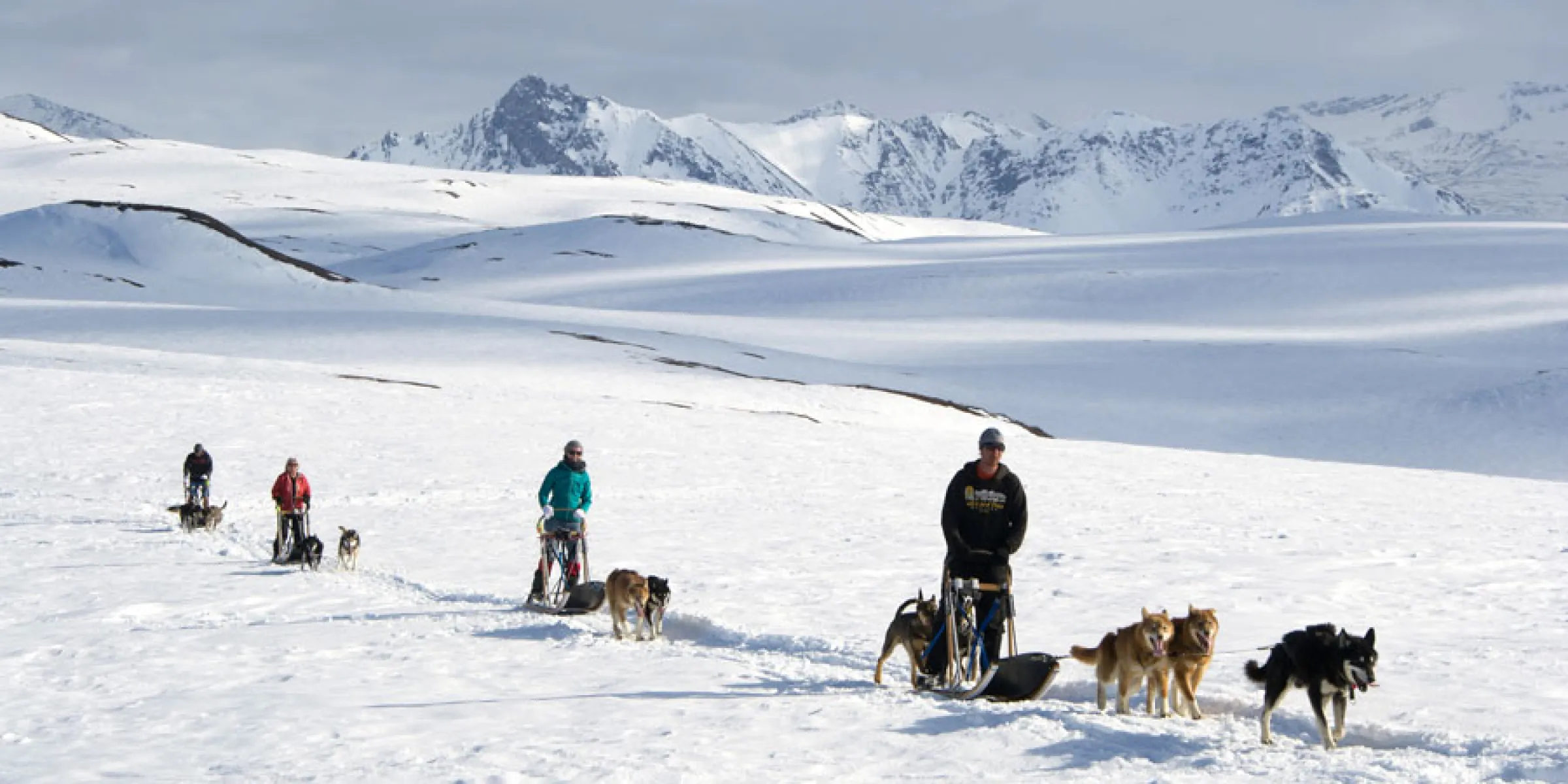
In the best of spirits, we arrive at the Wild and Free Arctic Camp with our dog sleds – four small “kick sleds” with four dogs each and Brent Sass's big “tourist sled.” In Alaska's evening sun it looks truly enchanting: Brent and his dogs have built a whole little snow-paradise village out here. For many years he has come to this part of the Arctic, about 8 miles from Galbraith Lake, at the start of spring to give himself and his dogs a break after Alaska's big races, the Iditarod and the Yukon Quest – and he always brings along a few puppies to camp that he left with his handlers during race training. His commitment to giving every dog in his kennel enough attention and training is really something special.
Arrival, evening and night are all about anticipation – of the dogs, the camp and of course everyone's first run. But first, take a look at where we've arrived:

Arctic deluxe – the camp in the vast expanse of northern Alaska
The camp consists of five wall tents, a big dog yard in the middle, a separate “snow pen” for the puppies, several “freezers” dug into the snow for all the food, and a “toilet” screened off by a snow wall, which we have to build higher every day because the snow has started to melt. The living and kitchen tent is lined with a green, carpet-like tarp and has a two-burner gas stove and a woodstove that keeps the whole tent and the pots warm. There's no shortage of equipment or food – a camping table, a small bar, crates and camp chairs for sitting in front of and inside the tent make this a cozy place to come together at any hour of the day or night.
Brent Sass lives in the second wall tent next door, and in another one below the dog yard lives a musher friend of his who heads out every day with her eleven dogs to hunt caribou – with great success. Our tour leader Murkel, the founder of murkl.com, opts – who would have expected anything else – for the outdoor version and pitches the Mountain Hardwear tent he brought along right next to the living and kitchen tent, without any “stove frills” at all – the straw that's plentiful at camp keeps him warm in the simplest but most effective way.
The two remaining tents are for the rest of the group: Kathi, Jonas, Marlis and I move into the four-person tent, where Kathi is promptly crowned “Heating Queen.” And indeed, we never once have to worry about it getting too cold in our cozy home. Thanks, Kathi! The excellent insulation in the tents does the rest – so “luxury camping” in the Arctic is very much our motto. Claudius and Josh Horst – our third guide besides Murkel and Brent, who handles the logistics and, in the smartest way, everything else we and the dogs need – share the two-person tent. A great combo, those two – a couple of real hands-on guys, as all the to-dos around camp will soon prove.

Wild and Free: beyond time and space in Alaska
By the first morning at the latest, life at the Wild and Free Arctic Camp in Alaska begins for us. The vastness of the Arctic quickly has an effect on all of us – an incredible sense of calm and ease, or exuberance, depending on how you're feeling at that hour of the day or night. It soon becomes clear that nothing has to be planned down to the minute and that it's perfectly fine to just take each day as it comes.
On top of that, spring has unexpectedly already arrived up here too. So much for ski pants and hats: the sun is already so warm that the snow melts during the day, and Josh and Claudius in particular are busy keeping the dog yards intact with enough snow walls. And this is what it looked like – as always, your comments are very welcome.
Even on the first day the snow gets very slushy during the day, and running under the already warm sun isn't exactly made for dogs used to the cold. So we spend our days at camp and start our runs in the evening – whether it ends up being 7 or 9 o'clock doesn't matter here either. What counts is how intensely you experience everything – whether it's snowshoeing, playing with the puppies, working around camp, cooking, doing the dishes or just lying in a deck chair in the sun. Everything is good, every idea is welcome, but nothing is a must.
Wild and Free: the first dog sled run
Before the test runs on the first evening after our arrival, we're really impressed by the instinct with which Brent Sass picks his dogs for us. Because for him one thing is clear: the dogs in front of our sled will be our companions for the next few days – in front of the sled, in the dog yard, while petting and playing, and above all while building trust in each other. As an inexperienced skier, I notice especially how much that counts. Once you've built a relationship with the animals, controlling the sled works too, even if you have no experience at all.

Brent and Josh take plenty of time to explain the “kick sleds” to us in a theoretical dry run. For those of us who had already driven a kick sled with three or four dogs all the way to camp on arrival the evening before – namely Jonas, Claudius and Marlis – it's good-to-know theory after the practice; for everyone else, it's the best dry run before the start.
Always hold on tight, keep your distance, don't forget the brake and keep an eye on the person behind you – those are the most important rules when dog sledding in a convoy in the Arctic and in Alaska.

And then we're off – the practice laps around the frozen lake begin. Kathi and I get to go first, since we rode in the “tourist sled” on the trip in. Only now do we really realize how sweaty dog sledding can be. Keeping your balance and staying upright while the sled does whatever it wants is another important lesson for us. After a few more practice laps by the guys among us, who are already “semi-pros,” we set off on a first longer, very flat beginner tour. Fantastic! Our dogs seem to enjoy it just as much as we do. The nature around us is simply gigantic. Far too soon, around midnight, we head back to camp. After a few thrilling stories from the guides about encounters with wolves and bears on countless caribou hunts, Jonas wonders around 3 a.m. why he's still wearing his sunglasses – Alaska, beyond time and space.

Wild and Free: with the dogs across Alaska's endless trails
Over the next few days the tours step up in every way: length, changing ground from snow to tussocks, all kinds of views, caribou sightings, growing fitness and, in the end, pure enjoyment on every level. Brent Sass always has the perfect touch when choosing where to go, of course also thanks to Josh and Murkel, with whom he talks things over. While Josh mainly helps the group with technical and athletic tips before and after the dog sled trips, Murkel makes sure to balance everyone's individual needs on the tours. For us, that adds up to a truly perfect mix that makes it very easy to get to know and experience Alaska and its wilderness in the gentlest way.
None of us wants to say goodbye to this place, to the dogs, to the solitude here – which really isn't solitude at all. The five days in the Arctic have flown by far too quickly. Imperceptibly, and yet lastingly, the fascination of Alaska has caught up with us.


